

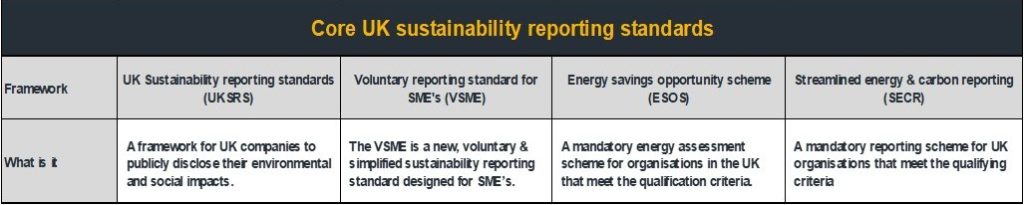
There’s a lot of complexity and fragmentation in sustainability reporting but for the majority of UK businesses these are the 4 standards & frameworks you need to know about.
With between 400 and 600 (no one really knows) sustainability standards and reporting frameworks in operation, its no wonder that businesses of all sizes and stakeholders such as investors are calling for standardisation, consolidation and less complexity. The good news is, to an extent, in the UK that’s happening with the introduction of the UKSRS and VSME frameworks. To learn more about these standards, the benefits and which businesses should use them read on….
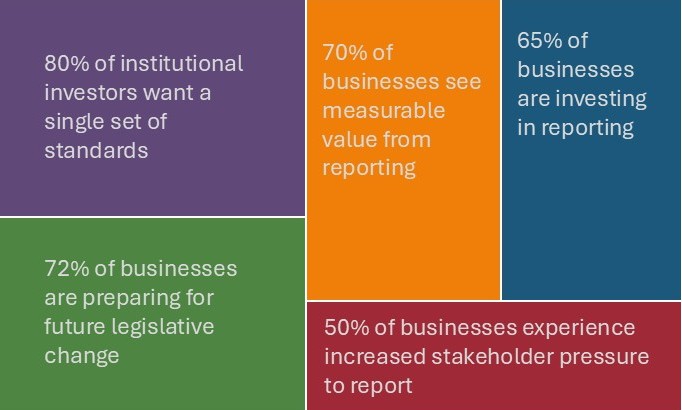
But first and despite all the fragmentation, here are some statistics which are encouraging. Based on a percentage of companies surveyed in 2025 by the big 5, its clear that stakeholder pressure and increasing investment in sustainable strategies and reporting is returning measurable ROI for both businesses that are mandated to report and who recognise the benefits of voluntary reporting.
UK Sustainability reporting standards (UKSRS)
What is it:
A framework for UK companies to publicly disclose their environmental and social impacts. It is expected the UKSRS will adopt the ISSB IFRS S1 & IFRS S2 standards which aim to provide consistent and comparable information for investors and other stakeholders. The final standard is due to be published and made available for companies to voluntary report from the end of 2025.
Reporting Type:
Initially Voluntary but the government and FCA are considering mandated reporting for certain UK entities.
Best for:
Larger UK businesses and organisations who are already subject to other mandatory reporting and businesses who want to unlock business value, attract investment and manage risk. For large businesses who are not mandated to report, especially those that sit in the value chain of mandated customers, the UKSRS, is the opportunity to improve environmental credentials, align with growing stakeholder & investor expectations to support their reporting and risk strategies and prepare for future mandated reporting requirements.
Objective:
The objective is to provide a globally recognised set of baseline reporting standards and consistent framework for companies to disclose their sustainability-related risks and opportunities. It aims to enhance transparency, inform regulators, stakeholder and investor decisions, and support the UK’s transition to a more resilient, sustainable economy.
Reporting Focus:
Sustainability reporting from the business and its associated value chain including environmental, governance and risk management metrics which are aligned to the ISSB standards as follows.
- IFRS S1: General requirements for disclosure of sustainability related financial information.
- IFRS S2: Climate related disclosures.
Who needs to report:
The UKSRS is voluntary and intended for larger private businesses and listed organisations. Currently the UK government and FCA are consulting on the definition & requirements for mandated reporting for certain UK entities.
Reporting period:
Annual
Audience:
Whether your reporting is mandated or voluntary those that will take an interest in your environmental performance include:
- Regulatory organisations
- Financial institutions & investors
- Customers whose value chain you sit in
- Supply chain partners
- Employees
Assurance requirements:
The assurance levels and requirements for entities that may be required to obtain assurance are still in development.
Voluntary reporting standard for SME’s (VSME)
What is it:
The VSME is a new, voluntary & simplified sustainability reporting standard designed for SME’s. Developed by the European Financial Reporting Advisory Group (EFRAG) it is based on the same rules and standards (such as the upcoming UKSRS framework) that large private businesses and listed organisations report against.
Reporting Type:
Voluntary.
Best for:
SME’s wanting to improve their environmental credentials, who want to unlock measurable business value and who understand the need to prepare for future legislative change while fulfilling the information & data demands of their stakeholders including investors and customers whose value chain they sit in.
Objective:
The VSME standard has been developed to provide a simplified & proportionate framework for SMEs to report accurately on sustainability data but with significantly less complexity than that required of large businesses and organisations. It is voluntary but enables SME’s to:
- Enhancing access to capital and financing
- Improve competitive advantage & market positioning.
- Increase operational efficiency and cost savings.
- Strengthen stakeholder trust & reputation.
- Get ready for future regulatory requirements
Reporting Focus:
Essential sustainability and ESG data and information across two modules as required.
- Basic module, focused on 11 disclosures – covering the reporting essentials including emissions data scopes 1&2, waste and policies such as data protection and anti-corruption.
- Comprehensive module, focused on 9 additional disclosures that include ESG strategies, climate targets and transformation plans.
Who needs to report:
The VSME is voluntary and intended for small to medium sized companies typically described as those with less than:
- < 250 employees
- < £50m in net sales
- < £25m balance sheet total
Reporting period:
Annual
Audience:
Whether your reporting is mandated or voluntary those that will take an interest in your environmental performance include:
- Financial institutions & investors
- Customers whose value chain you sit in
- Supply chain partners
- Employees
Assurance requirements:
There are no current assurance requirements.
Energy savings opportunity scheme (ESOS)
What is it:
Administered by the environment agency, ESOS is a mandatory energy assessment scheme for organisations in the UK that meet the qualification criteria. The Environment Agency is the UK scheme administrator.
Reporting Type:
Mandated for qualifying organisations.
Best for:
Any business that meets the mandated qualifying criteria.
Objective:
The ESOS audit is designed to identify tailored and cost-effective measures to allow participating businesses to save energy and achieve carbon and cost savings.
Reporting Focus:
Energy consumption and efficiency from within an organisation’s buildings, industrial processes and transportation.
Who needs to report:
Large UK businesses that have more than:
- >250 or more employees
- >£44m annual turnover
- >£38m annual balance sheet
Reporting period:
A qualifying business must carry out an ESOS assessments every 4 years.
Audience:
- Regulators (the environment agency)
Assurance requirements:
All participants need to have their ESOS assessment signed off by an ESOS lead assessor unless:
- 100% of their energy supplies are covered by ISO 50001
- The total energy consumption is less than 40,000 kWh.
Audit costs range between £5-15k standard and £25-50k complex
Non-compliance can result in substantial fines and enforcement by the Environment Agency.
Streamlined energy and carbon reporting (SECR)
What is it:
A mandatory reporting scheme for UK organisations that meet the qualifying criteria that aims to simplify and improve energy and carbon reporting. It requires businesses to calculate and report on their energy usage and greenhouse gas emissions. Moving into 2026, The SECR reporting framework will be absorbed into the UKSRS.
Reporting Type:
Mandated for qualifying organisations.
Best for:
Any business that meets the mandated qualifying criteria.
Objective:
Primarily, the SECR audit is designed to Increase awareness of energy costs within large and quoted organisations, including enhanced visibility to key decision makers. It also creates more of a level playing field among large organisations, in terms of energy and emissions reporting.
Reporting Focus:
Energy use and greenhouse gas (GHG) emissions
- Large UK companies need to report their UK energy use and associated greenhouse gas emissions as a minimum relating to gas, electricity and transport fuel, as well as an intensity ratio and information relating to energy efficiency action, through their annual reports.
- Quoted companies of all sizes are required to report their global greenhouse gas (GHG) emissions and an intensity ratio through their annual reports. Additionally, they are now required to report their total global energy use and information relating to energy efficiency action alongside the methodology used to calculate the new and existing disclosure requirements.
Who needs to report:
Companies that are:
- UK incorporated companies listed on the London stock exchange / EEAM, New York stock exchange / NASDQ
- Unquoted large companies incorporated in the UK, which are required to prepare a Directors’ Report under Part 15 of the Companies Act 2006
- Large Limited Liability Partnerships (large is defined as per the existing framework for annual accounts and reports, based on sections 465 and 466 of the Companies Act)
Reporting period:
Annual reporting as part of Companies House accounts submissions
Audience:
- Regulatory organisations
- Financial institutions & investors
- Supply chain partners
Assurance requirements:
As part of annual accounts submissions
Whether its mandated or voluntary there are many business benefits from engaging in sustainability (ESG) reporting. In our opinion, the top five are:
- Win business opportunities and contracts:
In the UK, many large businesses and all public sector organisations increasingly mandate and require existing and potential suppliers to demonstrate their performance in ESG reporting and in carbon reduction planning.
- Enhanced Access to Finance & Investment:
Banks and investors increasingly integrate ESG factors into the risks and opportunity of lending and investment decisions. Businesses with credible sustainability reporting often benefit from preferential lending rates, access to green finance products, and improved investor appeal.
- Cost Reduction & Operational Efficiency:
A typical businesses will report a 5 to 15% cost saving as a result of the insight gained from a properly implemented sustainability reporting process.
- Future-Proofing for Regulation:
UK sustainability regulations are evolving as is the pressure to satisfy information demands from investors, corporate and public sector organisations whose value chain businesses sit in. The earlier a business engages in reporting the better prepared it will be to support it customers and for the inevitable mandatory requirements coming to the UK.
- Feed deep insight into strategic decision making:
There is no doubt business and sustainability strategies go hand in hand. The structured data collection and analysis inherent in sustainability reporting feeds valuable business insight into overall strategic decisions, it identifies innovation opportunities, and helps align business strategy with long-term market trends and stakeholder expectations.
For UK businesses and organisations operating in the EU or globally.
If your business or divisions of it, are trading and operating within the EU or globally, you should explore any jurisdictional and mandated requirements that your business may be subject to for reporting purposes. Frameworks and standards where this may apply include:

If you’re unsure how to develop sustainability reporting strategies and objectives that align to your business and stakeholder needs, please get in touch.